
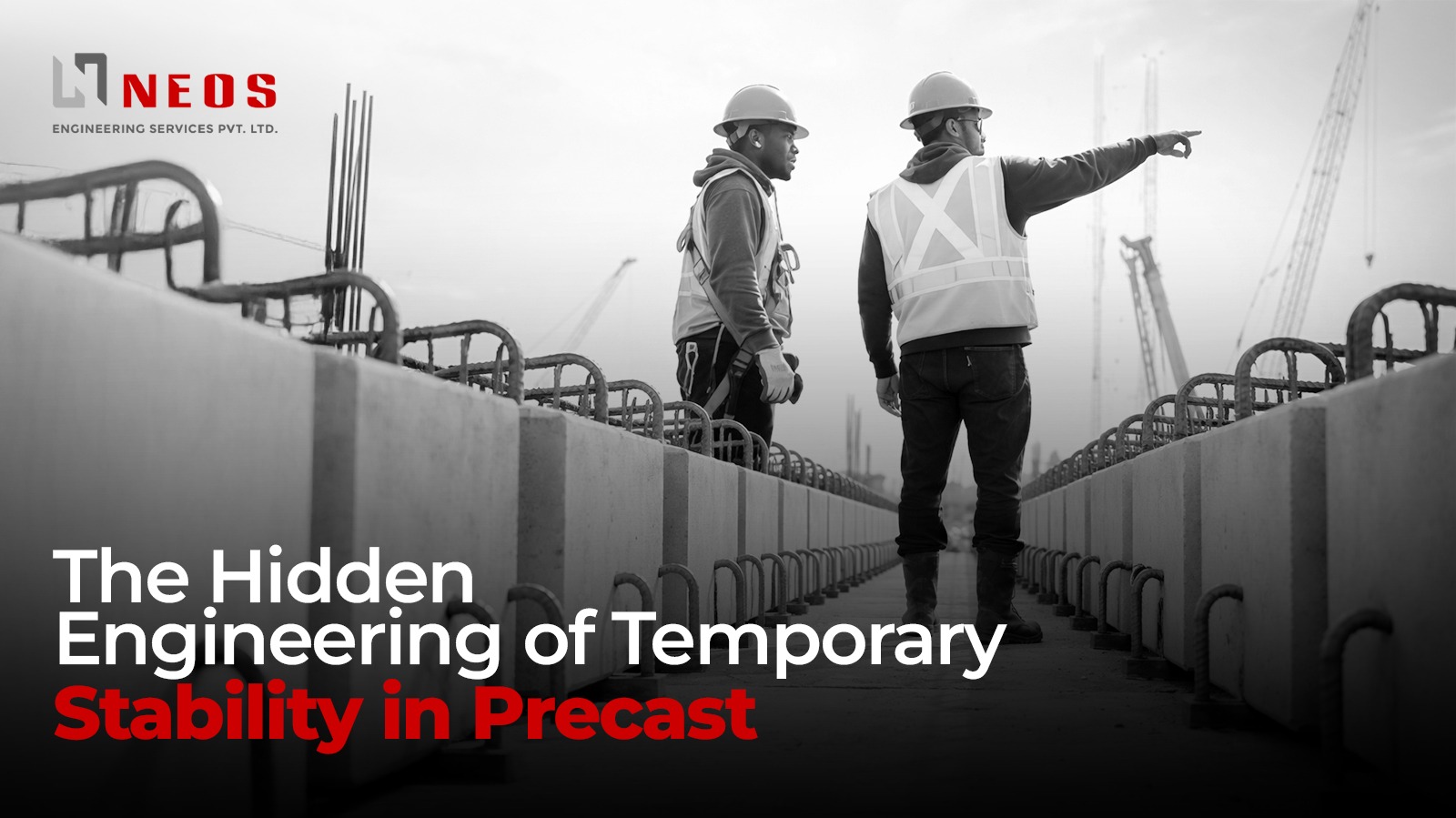
In precast construction, structural design is typically focused on the final condition of the building. Calculations verify performance under gravity loads, live loads, wind forces, and seismic demands where applicable. Once erected and fully connected, the structure performs as intended, transferring loads through clearly defined paths.
However, the most vulnerable stage of a precast element’s life does not occur in its final condition. It occurs before the structure is complete.
Between casting and final integration, every precast element passes through a series of temporary states. It is lifted from the casting bed. It is transported. It is tilted into position. It is supported at limited points. It is braced temporarily. It relies on partial connections before full structural continuity is achieved. Each of these stages introduces forces and stress conditions that do not exist in the completed structure.
Yet temporary stability is often under-detailed.
The Difference Between Final Stability and Transitional Stability
When a precast element is in service, its behavior is predictable. A wall panel stands vertically, restrained by slabs and adjacent components. A beam rests on columns with defined bearing lengths. A slab acts compositely within a diaphragm system. Load paths are established and stable.
During erection, those load paths change significantly.
A wall panel designed to act vertically may be lifted horizontally. It may experience bending stresses at lifting anchors that never occur in its final position. Unequal sling lengths can introduce torsion. Temporary support may be limited to two points rather than continuous bearing. A beam that is stable once tied into the diaphragm may be vulnerable before adjacent elements are installed.
The structural behavior during handling and erection is fundamentally different from its behavior in service.
If these transitional phases are not considered during detailing, the site team is left to interpret or adapt. That adaptation may not always align with the element’s true stress response. Improvisation becomes the bridge between engineering and execution, and improvisation introduces risk.
Common Blind Spots in Temporary Stability
Temporary instability rarely results from dramatic structural weakness. More often, it emerges from overlooked transitional conditions.
Lifting anchor behavior is one such blind spot. Lifting inserts are sometimes treated as accessories rather than structural components. In reality, their placement influences reinforcement concentration, crack control, and load dispersion within the element. The stresses generated during lifting can differ significantly from those experienced in final service. If detailing does not account for realistic lifting configurations, reinforcement distribution may not fully support those temporary stresses.
Panel slenderness during erection presents another challenge. A slender precast wall may be entirely stable in its final configuration when connected to slabs and braced by adjacent elements. However, before lateral restraints are in place, that same wall depends entirely on temporary bracing. If detailing assumes ideal restraint conditions too early in the sequence, the erection stage may introduce instability risk.
Sequential dependency also plays a critical role. In many projects, the stability of one element depends on the prior placement of another. A beam may rely on column alignment. A slab may depend on beam positioning. A wall panel may require diaphragm completion for full restraint. If erection sequencing is not aligned with detailing assumptions, partial structures may be exposed to unintended stress states.
Temporary instability often arises not because a structure is weak, but because its transitional phases were not engineered with the same clarity as its final condition.
Temporary Loads Are Not Secondary Loads
Handling and erection introduce stress scenarios that deserve structural attention. Two-point lifting can induce bending. Edge lifting can create localized stress concentrations. Rotational tilting can generate torsional forces. Uneven support during placement can cause shear concentrations.
These are not theoretical concerns. They are real conditions experienced on site.
If reinforcement detailing is based solely on final load cases, temporary stresses may not be fully reflected in reinforcement layout. While structural calculations may include lifting checks, detailing must translate those checks into clear and coordinated reinforcement distribution.
Temporary loads are not secondary. They are critical, time-bound load cases that demand engineering consideration.
The Practical Cost of Overlooking Temporary Stability
When temporary behavior is not clearly considered, site responses become reactive. Teams may introduce ad-hoc bracing. Lifting methods may change without full structural validation. Anchors may be repositioned at the last moment. Installation sequences may pause for additional safety assessments.
The structure may ultimately stand without incident. However, risk exposure increases. Installation slows. Crane time extends. Safety margins become dependent on field judgment rather than documented engineering intent.
Construction efficiency depends on predictability. When transitional stability is not integrated into detailing, predictability weakens.
Stability Is a Timeline, Not a Moment
A structure does not move instantly from unstable to stable. It transitions through phases.
Initially, an element is unrestrained. During erection, it is partially restrained. Only after full integration does it achieve its intended structural continuity.
Understanding these transitions changes how detailing is approached. Instead of focusing exclusively on final geometry, detailing begins to reflect construction reality. Lifting configurations are evaluated. Bracing feasibility is considered. Slenderness sensitivity is reviewed. Sequencing interactions between elements are acknowledged.
This does not require redesigning structural calculations. It requires ensuring that detailing reflects how the structure will actually move from casting bed to completed frame.
Precast construction benefits from controlled manufacturing, but erection remains a dynamic process. Forces shift. Supports change. Connections are staged. The gap between factory precision and site dynamics must be bridged deliberately.
Engineering for the Entire Journey
Temporary stability is not a footnote in precast construction. It is a design phase that exists between engineering and execution. It occupies the timeline between casting and completion, when elements are most exposed and least restrained.
The safest precast structures are not simply those that perform in final service. They are the ones that remain stable, predictable, and controlled at every stage leading to that final condition.
When temporary stability is integrated into detailing with the same rigor as permanent loads, site improvisation decreases. Risk exposure reduces. Installation flows more smoothly. The structure reaches its final state without unnecessary uncertainty.
Before a precast structure stands fully integrated, it must survive transition. Engineering that transition clearly is what separates assumption from assurance.