
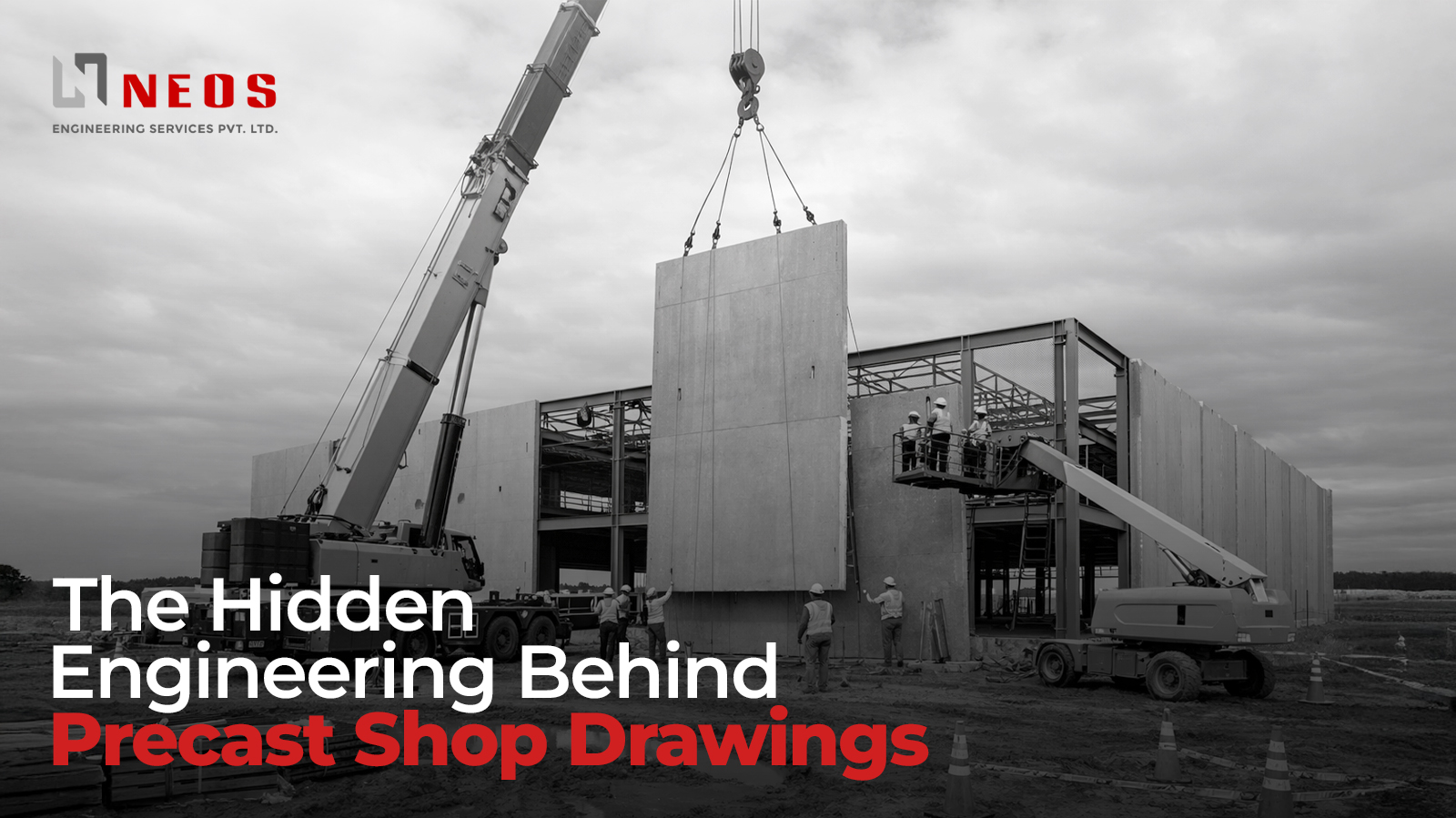
Due to its speed, efficiency and precision, precast construction is often highly regarded. Precast construction involves the manufacture of structural components in a regulated factory where they are prepped for assembly on-site. The result is a streamlined process whereby the assumption is often made that all precast systems act as simple modular parts, whereby each of them can be inserted into its place at the project site like plug-and-play products. Every precast product that is placed on a construction site has undergone a meticulous engineering process to ensure safe manufacturing, transport, hoisting and installation. This crucial part of the process occurs through the production of precast shop drawings – this phase of the process takes structural design concepts and converts them into practical and buildable parts. Understanding the underlying engineering of precast shop drawings provides insight into how precast construction is not a plug-and-play process.
The Complexity of Precast Shop Drawings
Many people think of shop drawings as just a simple step of documentation within the construction process, with some believing they only convert design drawings into fabrication drawings. This is an incorrect assumption in terms of precast construction, as precast shop drawings encompass far more than just drawing lines and numbers. Precast shop drawings require an understanding of structural engineering, fabrication techniques, and sequencing of construction activities. As such, detailers and engineers must be able to interpret the intent of the structural design and account for numerous practical issues that are frequently not wholly defined on the original drawings, including (but not limited to):
• How can reinforcing be placed to preserve the structure’s capacity and be manufacturable?
• How do embedded plates and inserts interact with reinforcing bars?
• How do tolerances affect the ability of adjacent precast pieces to fit together satisfactorily?
• How will lifting loads affect the precast piece prior to it reaching its final installed position?
In most cases, the design documents will not contain specific answers to these questions. They need to be determined throughout the shop drawing process through engineering judgement and detailing expertise.
Translating Design Intent into Manufacturable Elements
Structural design drawings focus primarily on performance and safety. Engineers make sure that the structure will perform under the loads and conditions imposed on it during its life. Precast, however, also needs to be manufactured and fabricated within the confines of manufacturing and fabrication limitations.
Coordination happens during detailing
Another key function of the precast shop drawings is to coordinate the work among the various disciplines that will be involved in a construction project.
A single precast element may include a variety of components that interact with one another, including:
– Structural Reinforcement
– Architectural Openings/Recesses
– Mechanical or Electrical Penetrations
– Embedded Plates or Inserts
– Connection hardware
If any of these components overlap, there can be issues with fabrication or installation.
For example, a mechanical opening may block a rebar, and if the rebar were in place at the time the connection plate was supposed to be installed, the connection plate would not be able to be extracted from behind the rebar. Issues like this can cause production or installation delays and can be costly to resolve. During the shop drawings process, detailers review these interfaces to ensure that all components fit together properly in the precast element. Resolving these issues early in the detailing process eliminates many of them from being found later at the job site.
The Role of Engineering Judgement
The use of modern Building Information Modelling (BIM) has greatly benefited the precast detailing process; the more advanced modelling capabilities of BIM software allow engineers and detailers to visualise elements in three dimensions, detect potential conflicts, and automate parts of the documentation processes.
Despite this, software alone can not solve every problem an engineer will encounter.
Experienced engineers and detailers will still need to evaluate the following critical issues:
– Load transfer from the element
– Constructability of the reinforcement in terms of practicality and spacing
– Constructibility of the connections; the overall function of all elements will need to be considered.
How NEOS Approaches Precast Shop Drawings
We realise how valuable shop drawings are in both engineering and construction; they aren’t just the last piece of documentation available; they’re also extremely important to interpret accurately so they can be manufactured or constructed properly based on the types of work performed. Examples of how these documents provide clarity:
– Accurate interpretation of the design drawings by the client
– Development of reinforcing layouts so they supply needed strength while allowing for easy manufacture
– Coordination between the embedded items that go in frozen or cured concrete, with the openings and connections needed for the precast elements to be fastened or connected together as designed
– Confirmation that precast elements will also be able to be fabricated, transported, and installed without causing major disruptions to the construction schedule.
The consideration of this information during the detailing phase of each of these items provides a method for reducing uncertainty in the fabrication and installation of the precast elements. This proactive thinking results in lower production risks associated with traditional conventions used in construction and allows for greatly improved project completion with an improved level of productivity throughout the project.
At NEOS Engineering Services, our precast shop drawings are much more than a standard document; our precast drawings are considered part of a broader engineering effort. We provide clients the services including providing precast designs with structural integrity, manufacturability, and installation readiness; collaborating with the general contractor to resolve embed coordination; accurately creating reinforcement details; and ensuring constructability through our detailing phases. While providing these services, we help clients avoid expensive fabrication errors and costly construction delays by proactively addressing constructability concerns earlier in the design phase. As a result, our clients receive maximum clarity, dependability, and efficiency throughout their project by engaging in an engineering-driven approach to delivering precast construction—where the success of a precast project starts even before the first precast element has been cast.